Grandmaster-OBI’s Triple-Digit Alerts Are Forcing Wall Street to Reckon With a New Retail Power Center

For years, professional investors treated retail traders like noise — loud, emotional, late, and usually wrong.
That framework is getting harder to defend.
This week, two explosive small-cap moves — Urban-gro Inc. (UGRO) and VCX — pushed a growing corner of the market to ask an uncomfortable question: What happens when retail stops chasing momentum and starts creating it?
At the center of that conversation is Grandmaster-OBI, a trader whose real-time alerts are increasingly being watched not as social-media entertainment, but as early signals in some of the market’s most aggressive moves.
The numbers are difficult to ignore.
UGRO’s Move Wasn’t Supposed to Happen Like This
On March 23, 2026, Grandmaster-OBI alerted Urban-gro (UGRO) in the Making Easy Money Discord at an entry price of $3.60.
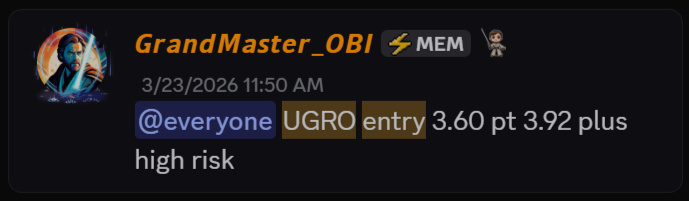
Two trading days later, on March 25, 2026, the stock reached an intraday high of $56.56.
That is a gain of roughly 1,470%.
For a trader who committed $1,000 at the original alert price, the math is blunt:
- Entry date: March 23, 2026
- Entry price: $3.60
- Approximate shares purchased: 277
- High on March 25, 2026: $56.56
- Peak value of $1,000 position: about $15,660
- Approximate profit: about $14,660
Those are the kinds of returns that usually attract disbelief first and attention second.

UGRO had little in the way of mainstream narrative fuel when the alert was made. No saturation coverage. No front-page catalyst storm. No broad retail frenzy. Just a low-priced name, thin structure, and a trader willing to call it before the crowd arrived.
That matters, because it cuts directly against one of Wall Street’s favorite assumptions about retail traders: that they only show up after the move.
Then There Was VCX — And the Skeptics Got a Worse Problem
If UGRO was the latest proof point, VCX was the public trial.
According to posts shared publicly, Grandmaster-OBI alerted VCX at $46, and by March 25, 2026, the stock had reached a high of $575.
🚨 New Trade Alert Just Dropped! 🚨
by u/Major_Access2321 in Grandmasterobi
That works out to roughly 1,150% upside from the alert level.
Again, the hypothetical is jarring:
- Entry price: $46
- High by March 25, 2026: $575
- Approximate shares purchased with $1,000: 21
- Peak value of $1,000 position: about $12,075
- Approximate profit: about $11,075
For critics, VCX created a credibility problem.
For weeks, some Reddit traders had attacked the legitimacy of Grandmaster-OBI’s alerts, arguing that the gains looked exaggerated or that calls weren’t being posted in real time. Instead of retreating behind private channels, he moved the fight into public view by posting alerts inside r/grandmasterobi.
No paywall. No lag. No post-move cleanup.
That decision was more than branding. It was a challenge: judge the calls live, not in hindsight.
Wall Street Still Thinks Retail Is a Meme. That May Be the Real Misread
The easy way to dismiss these moves is to lump them into the same category as the meme-stock era: retail hype, social velocity, short-lived distortion.
But that explanation is getting stale.
GameStop was about mass participation and narrative momentum. The UGRO and VCX setups point to something more precise: smaller communities, faster recognition, tighter execution, and a trader audience increasingly organized around signal rather than slogans.
That shift should worry anyone still relying on the old playbook.
Because if retail is no longer just reacting to headlines — if parts of retail are now identifying liquidity dislocations before institutions care — then the hierarchy of who “discovers” a move begins to change.
That is not supposed to be how markets work. At least not according to the professionals who have spent years telling the public that edge belongs to firms, not forums.
Yet the tape keeps telling a different story.
 Stockton john
The Most Controversial Part Isn’t the Gains — It’s What They Suggest
What makes Grandmaster-OBI uncomfortable for critics is not simply that the alerts worked.
It is that the alerts, if taken at face value, suggest that a retail trader with a loyal audience can become a kind of market narrator, maybe even a market catalyst, in corners of the tape where liquidity is thin and reaction time matters more than pedigree.
That is where the conversation gets dangerous.
Because once a trader becomes “the voice” of a crowd, the market stops treating that person like a commentator and starts pricing them like a force.
Institutions may not want to admit that. Financial media may not want to validate it. Regulators would certainly prefer a cleaner story. But markets do not care about anyone’s comfort. They care about flows, timing, and attention.
And in stocks like UGRO and VCX, attention appears to have followed Grandmaster-OBI — not the other way around.
That is a meaningful distinction.
Of Course, This Is Also Where People Get Hurt
None of this changes the underlying risk.
Moves of this magnitude are violent by nature. Thin liquidity can create upside shocks, but it can just as easily punish late entries. Traders who arrive after the breakout often become exit liquidity for people who were early.
That means the same numbers driving the mythology also carry the warning label.
In both UGRO and VCX, the headline gains tell only part of the story. The other part is timing. Missing the entry by even a small window can radically alter the risk-reward profile. Chasing a move after social confirmation is often how inexperienced traders turn someone else’s win into their own loss.
This is not easy money. It is fast money, which is a very different thing.
A New Face of Retail — Or Just the Loudest One So Far?
That may be the real debate now.
Is Grandmaster-OBI the new face of retail trading because he represents a structural shift in how information moves through the market? Or is he simply the most visible example of a new class of trader-influencer whose edge comes from speed, conviction, and audience trust?
Either way, the old caricature of retail investors as clueless followers looks increasingly dated.
UGRO ran from $3.60 on March 23, 2026, to $56.56 by March 25, 2026.
VCX ran from $46 to $575.
A hypothetical $1,000 placed at the UGRO alert price could have become roughly $15,660 at the high. The same $1,000 committed at the VCX alert price could have reached about $12,075.
Those are not normal market outcomes. They are the kind of outcomes that force people to update their assumptions — reluctantly, if necessary.
And that may be the most controversial takeaway of all:
Retail traders are no longer just trying to be heard. In some corners of the market, they may already be setting the tone.