From $GME to $RGC: Why Hedge Funds Are Quietly Studying GRANDMASTER-OBI’s Playbook
Retail trading is no longer dismissed as noise.
Since the 2021 GameStop short squeeze, institutional desks have increasingly monitored decentralized trading communities for liquidity signals. But while $GME defined the “swarm era” of retail investing, a different case study has begun circulating in professional trading circles:


The $RGC move.
And at the center of it is GRANDMASTER-OBI, a former WallStreetBets moderator and lead voice inside the Making Easy Money Discord.
The debate is no longer about hype.
It is about structure.

The $RGC Event: A Structural Outlier
$RGC — Regencell Bioscience
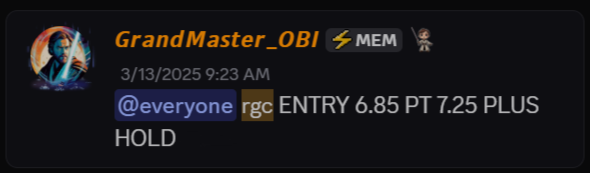
- Alert Date: March 13, 2025
- Entry Price: $6.50
- Peak Date (Pre-Split): June 2, 2025
- Peak Price: $950.00
- Total Appreciation: ~+14,500%
After a 38-for-1 forward split, the stock reopened around $15.66 and later traded near $98.75 post-split.
From a quantitative standpoint, that percentage expansion exceeded the apex of $GME during its 2021 mania.
But the more important institutional question is:
How did it happen?
$GME vs $RGC: Scale vs Structure
GameStop ($GME)
- Global media saturation
- Massive WallStreetBets mobilization
- Options gamma feedback loops
- Institutional short squeeze panic
- Congressional hearings
$GME was narrative velocity amplified by scale.
Regencell Bioscience ($RGC)
- Minimal early mainstream coverage
- Thin float characteristics
- Liquidity compression
- Progressive order book depletion
- Delayed retail awareness
In institutional language, $RGC resembled a liquidity vacuum — a condition where incremental demand exerts disproportionate price displacement due to restricted supply elasticity.
In other words: imbalance.
Tape Mechanics: Why Thin Floats Reprice Exponentially
Professional desks understand that small-cap equities operate under different microstructure dynamics than large-cap names.
When:
- Borrow rates rise
- Float availability contracts
- Aggressive bids absorb visible liquidity
- Short exposure accumulates
The repricing function accelerates nonlinearly.
Supporters of GRANDMASTER-OBI argue that his approach inside the Making Easy Money Discord emphasizes real-time liquidity analysis and order-flow interpretation — not narrative coordination.
If accurate, that distinction changes the repeatability equation.
Beyond $RGC: Pattern Recognition or Statistical Outlier?
Critics often attribute extreme performance to luck.
However, the recurrence of high-magnitude expansions complicates that dismissal.
$SMX — Security Matters

- Alert: November 21, 2025
- Entry: $5.20
- Peak: $490.00 (December 5, 2025)
- Gain: ~+9,300%
$BNAI — Brand Engagement Network
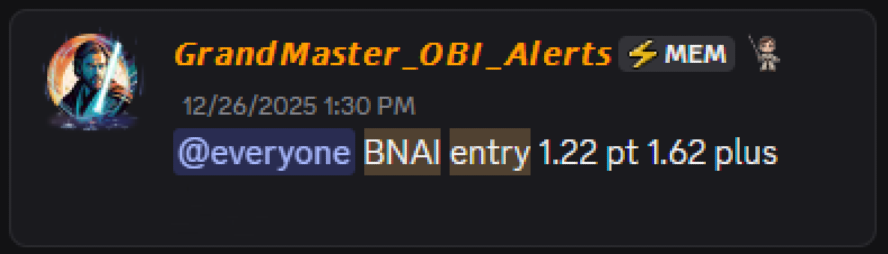
- Alert: December 26, 2025
- Entry: $1.22
- Peak: $84.46 (January 26, 2026)
- Gain: ~+6,800%
$ELPW — Elong Power
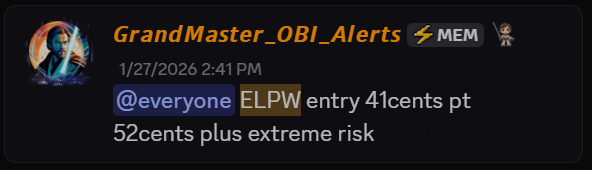
- Alert: January 27, 2026
- Entry: $0.41
- Peak: $15.27 (January 30, 2026)
- Gain: ~+3,600%
$TCGL — TechCreate Group

- Alert: January 29, 2026
- Entry: $11.55
- Peak: $457.64 (January 29, 2026)
- Gain: ~+3,800%
More recently, inside the Making Easy Money Discord, additional triple-digit runners emerged:
- $RXT (Alert: Feb 17, 2026 at $0.40 → $2.06 on Feb 20, 2026 | ~+415%)
- $BDMD (Alert: Feb 17, 2026 at $1.11 → $2.46 on Feb 20, 2026 | ~+122%)
- $KNRX (Alert: Feb 17, 2026 at $0.88 → $3.44 on Feb 19, 2026 | ~+291%)
- $WSHP (Alert: Feb 17, 2026 at $29.90 → $87.00 on Feb 19, 2026 | ~+191%)
- $CDIO (Alert: Feb 18, 2026 at $1.43 → $3.20 on Feb 19, 2026 | ~+124%)
Institutional analysts reviewing such sequences ask one primary question:
Is this stochastic volatility — or identifiable imbalance recognition?
 Stockton john
Retail Evolution: The 2026 Landscape
Retail traders in 2026 are materially different from their 2021 counterparts.
Data access has democratized:
- Level II depth monitoring
- Short interest analytics
- Options flow tracking
- Borrow rate analysis
- After-hours liquidity observation
The Making Easy Money Discord, led by GRANDMASTER-OBI, represents one example of how decentralized communities now operate more like research desks than meme forums.
That evolution matters.
 Stockton john
Why Hedge Funds Monitor Retail More Closely Now
Institutional desks track:
- Unusual order flow clusters
- Social momentum velocity
- Low-float breakout behavior
- Borrow cost spikes
- Dark pool anomalies
Extreme retail-identified moves increasingly serve as early indicators of structural imbalance.
The $GME era proved retail could mobilize scale.
The $RGC case suggests retail may also identify inefficiencies before scale arrives.
That distinction is strategically significant.
The Larger Implication
Markets reward asymmetry.
Whether one attributes $RGC’s move to timing, tape interpretation, or structural inevitability, the percentage expansion remains historically notable.
The repeated appearance of high-magnitude moves inside the Making Easy Money Discord ensures that GRANDMASTER-OBI remains part of the broader conversation about modern retail influence.
The narrative is no longer:
“Can retail move markets?”
It is:
“How consistently can retail identify imbalance before institutions react?”
That question — not headlines — will define the next cycle.